Low-altitude aviation is extending the functional boundary of cities into three-dimensional airspace,
but urban infrastructure is not advancing at the same pace as aircraft technologies. In dense built
environments, building-induced flow phenomena create highly non-uniform wind fields that can
compromise unmanned aerial vehicles and electric vertical take-off and landing aircraft. This talk
introduces low-altitude wind engineering as an emerging interdisciplinary field concerned with the
characterization, prediction, assessment, and engineering control of wind within the urban flight
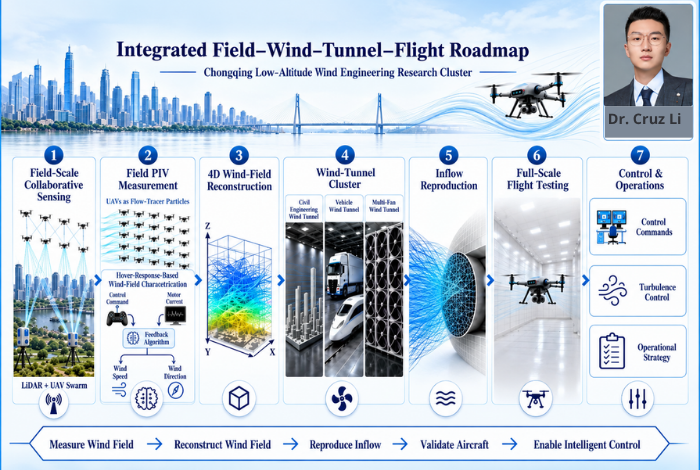
envelope. An integrated framework is presented, linking field sensing, wind-field reconstruction,
wind-tunnel testing, numerical simulation, risk evaluation, and intelligent control. Five interconnected
challenges are addressed: rooftop vertiport design; local flow control through parapets, edge shaping,
and guide devices; wind-aware urban air corridors; real-time monitoring, digital twins, and
operational decision support; and retrofitting existing buildings and infrastructure. The talk advocates
a shift from isolated vehicle testing toward a city-scale system coupling atmospheric sensing,
computational models, structural assessment, and flight operations, turning existing urban assets into
safe, adaptive low-altitude infrastructure.
Dr. Cruz Li is the Hongshen Excellence Professor of Fluid Mechanics and Built Environment at
Chongqing University, China. He received his PhD in Civil Engineering from the Hong Kong
University of Science and Technology under the Hong Kong PhD Fellowship Scheme, and his BSc in
Engineering Mechanics from the University of Wisconsin-Madison with Dean's Honors. His current
academic appointments include Associate Editor, Physics of Fluids (SCI Q1), American Institute of
Physics, USA; Coordinator of the Non-Synoptic Winds Task Group, International Association for
Wind Engineering; Co-coordinator, Center for Low-Altitude Wind Engineering (cLAW), State Key
Laboratory of Safety and Resilience of Civil Engineering in Mountain Areas, China; and China
Regional Representative & Fellow, World Society of Sustainable Energy Technologies. His plenary
and invited speaking engagements include the 8th International Symposium on Computational Wind
Engineering (2026), the 2026 Drone World Congress, the 2025 Urban Physics Advanced School, the
2024 Structures Congress, and the University of Wisconsin-Madison's 2018 Graduation Reception.
His research focuses on urban microclimate, wind engineering, turbulent flows, and data-driven
modelling. Since publishing his first paper in 2020, he has authored 52 Q1 journal articles, attracting
more than 1,500 citations with an h-index of 22. In the field of Koopman operators and dynamical
systems, Scopus-based metrics rank him 5th worldwide in views and 13th in citations, and 1st and 3rd
in China, respectively. Dr. Li founded and guest-edited Flow and Civil Structure, the first
interdisciplinary special issue connecting fluid mechanics and civil engineering, which published 195
Q1 articles in Physics of Fluids. Born in Chongqing, he grew up in Ethiopia from the age of twelve
and lived across Africa, North America, and Europe for seventeen years before returning home.
Nato a Chongqing, dall’età di dodici anni è cresciuto in Etiopia e ha vissuto per diciassette anni tra Africa, Nord America ed Europa, prima di fare ritorno nella sua città natale.