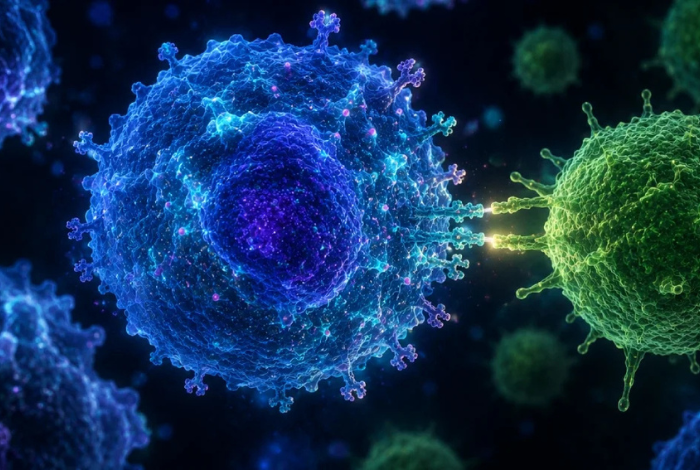
Chemotherapy does not act on cancer cells solely by eliminating them: in some cases, cells that survive treatment can enter a particular state known as cellular senescence, in which they stop growing but remain alive and metabolically active, profoundly changing their behavior.
In particular, the study results showed that, in a subgroup of samples from patients with acute myeloid leukemia (AML), the process induced by chemotherapy had an important consequence: leukemia cells became more recognizable to T lymphocytes, the immune system cells capable of identifying and attacking abnormal cells.
The research was coordinated by Raffaella Di Micco, group leader of the Senescence in Stem Cell Aging, Differentiation and Cancer Unit at the San Raffaele Telethon Institute for Gene Therapy (SR-Tiget) and Associate Professor of Pathology at the IUSS School for Advanced Studies in Pavia, and was also supported by Fondazione AIRC.
The findings, published in Nature Communications, were obtained through laboratory experiments on samples derived from patients with AML. The researchers observed that when leukemia cells enter senescence following chemotherapy, the expression of HLA molecules on their surface increases. These molecules act somewhat like molecular “display windows”: they present small fragments of cellular proteins, thereby helping T lymphocytes recognize the cell as abnormal and become activated against it.
The data also enabled the researchers to identify an epigenetic mechanism, that is, a system that regulates gene activity without altering the DNA sequence. This mechanism could explain why the phenomenon occurs in some samples, referred to as “senescence high,” but not in others, termed “senescence low.” In the latter, in particular, certain programs involved in the immune response appear to remain more strongly suppressed.
This led the researchers involved in the study to a second insight: if this “brake” contributes to making certain leukemia cells less recognizable to the immune system, targeting the epigenetic mechanism could increase their immunological visibility. In laboratory experiments, the researchers therefore tested a drug already approved for clinical use that is capable of acting on this mechanism, resulting in greater HLA molecule expression and improved T-cell activation. These findings do not yet point to a new treatment for patients, but they open up the possibility of studying senescence as a potential biomarker of differences in the immune response to chemotherapy and, in the future, exploring new combination treatment strategies.
Acute myeloid leukemia and the challenge of relapse
Acute myeloid leukemia is an aggressive blood cancer that remains difficult to treat, progresses very rapidly, and is extremely heterogeneous. It is characterized by the accumulation in the bone marrow and blood of immature myeloid cells, known as blasts, which interfere with the normal production of blood cells. It can occur at any age but is more common among older adults.
In Italy, approximately 50 new cases of AML per million people are estimated to occur each year. Globally, according to analyses based on the Global Burden of Disease 2021, approximately 145,000 new cases were estimated in 2021.
Growing knowledge of the genetic and molecular characteristics of AML has made it possible in recent years to refine disease classification and introduce targeted therapies. Chemotherapy, however, remains the treatment of choice for many patients and, under certain circumstances, may be followed by allogeneic hematopoietic stem cell transplantation.
One of the main challenges is posed by leukemia cells that survive treatment and may contribute to disease persistence or recurrence. Understanding what happens to these cells and how they subsequently interact with the immune system is therefore a central area of AML research.
At San Raffaele, previous research in this field had already identified mechanisms through which, in relapses following transplantation, leukemia cells can reduce HLA molecule expression and evade immune recognition. The new findings have made it possible to investigate the opposite phenomenon: what happens to the immunological visibility of leukemia when cells enter senescence in response to chemotherapy.
What happens to leukemia cells after chemotherapy
The researchers studied samples from 21 patients with newly diagnosed acute myeloid leukemia who had not yet received chemotherapy, exposing the leukemia cells in the laboratory to cytarabine, a chemotherapy drug commonly used to treat AML. Not all samples responded in the same way:
- in 15 of the 21 samples, a proportion of the cells developed characteristics consistent with senescence following treatment; these samples were classified as “senescence high”;
- in the other six samples, classified as “senescence low,” this response was much less pronounced.
What is senescence in oncology?
Senescence should not be confused with cell death or cellular quiescence. A senescent cell stops proliferating, generally in a stable manner, but remains alive and metabolically active, altering the activity of numerous genes as well as its interactions with the surrounding environment. In oncology, this phenomenon can have different effects:
- in the short term, the arrest of proliferation can contribute to tumor control and, as the results of this study suggest, may make certain cancer cells more recognizable to the immune system;
- however, if senescent cells persist in the body for a long time, they can contribute to the development of a chronically inflammatory environment that, under certain conditions, promotes treatment resistance and disease progression.
In the new study, the researchers focused primarily on what happens during the early stages following treatment.
Senescent cells become more “visible” to the immune system
The researchers observed that in “senescence high” samples, chemotherapy activates molecular programs associated with inflammation and interferons and increases the presence of class I and class II HLA molecules on the surface of leukemia cells.
The effect was not merely molecular. In co-culture experiments, in which leukemia cells and T lymphocytes from the same patient were grown together to observe their interactions, chemotherapy-treated “senescence high” leukemia cells induced greater proliferation of CD4+ and CD8+ T lymphocytes than “senescence low” cells.
Further experiments confirmed the role of HLA molecules: when the researchers blocked their function, T lymphocytes showed reduced activation against the leukemia cells, demonstrating that the increased visibility of these cells depends specifically on HLA molecules.
“Our results indicate that therapy-induced senescence is not simply a state in which the leukemia cell stops proliferating. In some samples, it also changes the dialogue between the tumor and the immune system, increasing the ability of leukemia cells to present antigens and be recognized by T lymphocytes,” explains Raffaella Di Micco. “However, it is important to emphasize that not all samples respond in this way: understanding the origin of this difference is precisely one of the most interesting aspects of our work.”
An epigenetic “brake” can reduce leukemia visibility
To understand why some leukemias develop this response while others do not, the researchers also analyzed epigenetic mechanisms, which regulate gene activity without altering the DNA sequence. These include the PRC2 protein complex, of which EZH2 is a key component.
“In ‘senescence low’ samples,” explains Simona Fusco, co-first author of the paper, “we observed greater activity of this inhibitory system before treatment. Some of the genes involved in the immune response were therefore more strongly ‘suppressed’ and consequently less able to become activated. This may help explain why, following chemotherapy, these cells show a smaller increase in HLA expression and remain less recognizable to the immune system.”
To determine whether this mechanism could be targeted, the researchers treated “senescence low” cells in the laboratory with tazemetostat, a drug already approved for clinical use that selectively inhibits EZH2. The treatment reduced the epigenetic “brake” in DNA regions involved in immune and inflammatory responses and increased the expression of class I and class II HLA molecules. The treated cells also became more capable of stimulating the proliferation of CD4+ and CD8+ T lymphocytes.
This result indicates that pharmacologically modifying certain epigenetic mechanisms could, in the future, represent a potential strategy for increasing the immunological recognition of certain leukemia cells.
“These data tell us, above all, that the response to chemotherapy can have different immunological effects from one patient to another,” Di Micco adds. “The next step will be to determine whether the ability of leukemia cells to enter senescence could also become a biomarker that can help identify patients with different immune responses to chemotherapy.
“At the same time, we want to further investigate the possibility of combining chemotherapy with immunotherapies based on engineered T cells and/or drugs capable of targeting the epigenetic mechanisms that regulate the visibility of leukemia cells to the immune system. These approaches still require validation in larger groups of patients, as well as dedicated preclinical and clinical studies, before their application in clinical practice can be considered.”
The research received support from several national and international organizations: Fondazione AIRC per la Ricerca sul Cancro, Fondazione Telethon, Human Frontier Science Program, American Society of Hematology, New York Stem Cell Foundation, European Research Council (ERC), European Hematology Association, Leukemia Research Foundation, and the Italian Ministry of Health.
Read the full article: https://doi.org/10.1038/s41467-026-76853-1