Date
Wed, 16/09/2026
What does it mean to do mathematics in the age of artificial intelligence? Silvia De Toffoli, Associate Professor at the Scuola Universitaria Superiore IUSS di Pavia, and Eamon Duede (Princeton University and Purdue University) address this question in an article published in “Le Scienze”, starting from recent advances in AI in solving complex mathematical problems.
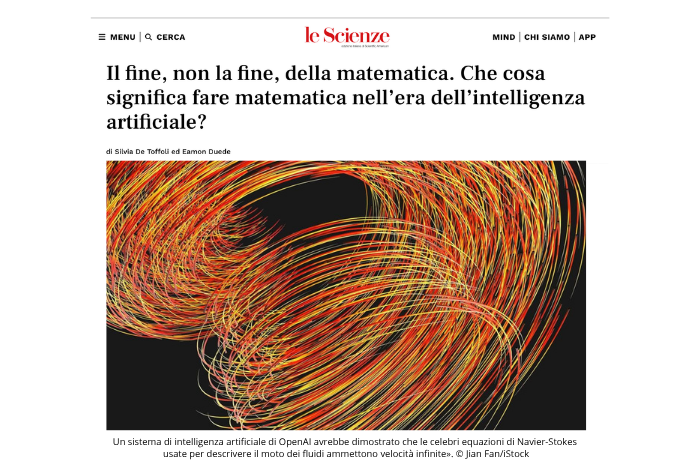
“The Purpose, Not the End, of Mathematics. What Does It Mean to Do Mathematics in the Age of Artificial Intelligence?” is the title of the article by Silvia De Toffoli and Eamon Duede, published in Le Scienze on 15 September 2026.
At the heart of their reflection is a question that is likely to become increasingly relevant: when artificial intelligence finds the answer to a complex mathematical problem, can we say that the problem has truly been solved?
Taking the recent case of the Navier–Stokes equations as a starting point, De Toffoli and Duede highlight a fundamental distinction: providing an answer, even one that is formally certified, does not necessarily mean producing a solution capable of generating understanding and new knowledge. A mathematical proof must be understandable, interpretable and capable of being used to develop new ideas and advance the discipline.
But their reflection goes beyond AI’s ability to solve problems. Mathematics is not simply about problem-solving: it also involves developing new concepts and theories, formulating new questions, connecting different fields, and building knowledge within a scientific community.
This is the idea behind the play on words in the title of the article: artificial intelligence does not necessarily signal the “end” of mathematics; rather, it provides an opportunity to reconsider its “purpose” — the goals of mathematical research and which of those goals we want AI to help us pursue.
🔗 Read the full article in “Le Scienze”.