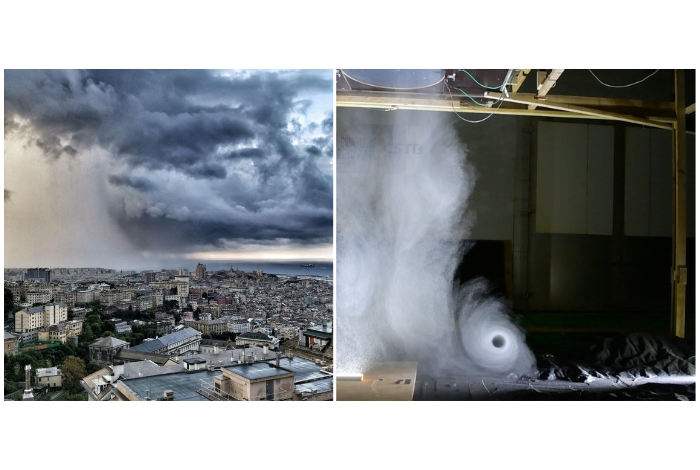
Physical characterization of thunderstorm winds 6 november 2026
6 November 2026, 2:00 PM (CET)
IUSS Pavia – Room 1.15, Palazzo Broletto, Pavia
On 6 November, Dr. Federico Canepa, researcher at the University of Genoa and expert in wind engineering, will deliver a seminar entitled “Physical Characterization of Thunderstorm Winds”.
The seminar will explore extreme thunderstorm winds, an increasingly relevant topic in the context of climate change. Combining full-scale field observations with wind tunnel experiments, the lecture will present recent approaches to understanding the dynamics of these phenomena and assessing their impacts on the natural and built environment.
The seminar will be held both in person and online.
Zoom link: Join the seminar
Climate change is contributing to the increasing frequency and intensity of severe thunderstorms, driven by global warming and rising atmospheric moisture. Despite their growing global relevance, these events remain highly localized in space and time, making their monitoring and characterization particularly challenging. Recent advances in wind-monitoring networks across the northern Mediterranean, together with remote-sensing
technologies such as LiDAR, have enabled more detailed investigations of the spatial and temporal evolution of thunderstorm outflows. However, full-scale observations alone cannot fully resolve their complex dynamics. Physical modelling in specialized experimental facilities provides a complementary approach. Experiments at the WindEEE Dome (Western University, Canada) have investigated the three-dimensional interaction between downburst outflows, atmospheric boundary layer (ABL) winds, and storm translation. More recently,
experiments at the Jules Verne Climatic Wind Tunnel (CSTB, France) have explored the influence of thermodynamic effects on thunderstorm outflows. Combining full-scale observations and laboratory experiments, this lecture will review current approaches to the physical characterization of thunderstorm winds, focusing on the mechanisms governing their spatial and temporal evolution. The ultimate aim is to improve our understanding of these
extreme events and support more physically based assessments of their impacts on the natural and built environment.