Gamma-ray bursts shed new light on the Milky Way: IUSS researcher helps redraw our Galaxy
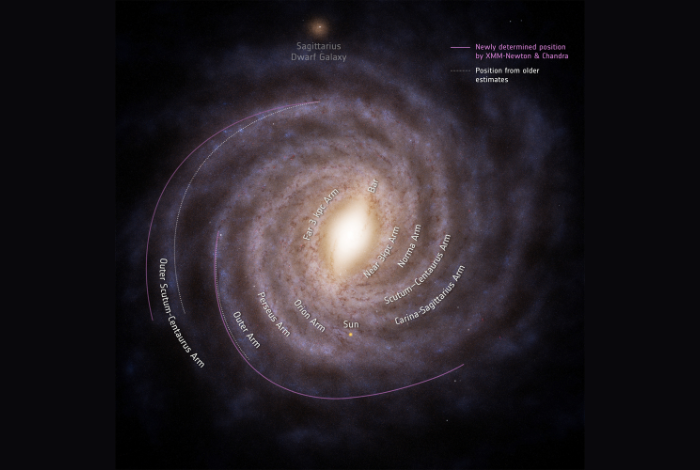
An international study led by the Italian National Institute for Astrophysics (INAF), published in Astronomy & Astrophysics, has produced the most accurate measurements ever obtained for the distances of the Milky Way's outer spiral arms. The findings reveal that these structures extend up to 10% farther than previously estimated.
The paper's first author is Beatrice Vaia, an INAF researcher who carried out the study during her PhD at the University of Trento and the Scuola Universitaria Superiore IUSS Pavia.
To overcome the challenge of mapping our Galaxy from within, the team exploited an innovative technique based on X-ray scattering rings produced when powerful gamma-ray bursts (GRBs) from distant galaxies cross interstellar dust clouds in the Milky Way. These X-ray "light echoes" provide a direct geometric method to measure the distances of dust clouds and, consequently, the Galaxy's spiral arms.
"We used X-ray scattering rings as a purely geometric tool," explains Beatrice Vaia. "Unlike traditional methods, this technique does not rely on models of the Milky Way's rotation, which become highly uncertain in its outermost regions. It allowed us to improve the three-dimensional map of our Galaxy and independently test current models of its structure."
Using archival observations from NASA's Chandra X-ray Observatory and ESA's XMM-Newton telescope, the researchers measured the distances to the Perseus Arm, the Outer Arm and the Outer Scutum-Centaurus Arm.
The study shows that the latter two spiral arms lie about 10% farther away than previously thought. For the Outer Scutum-Centaurus Arm, located more than 60,000 light-years from Earth, the team achieved a record distance measurement with only a 1% uncertainty.
These results provide new insights into the structure of the Milky Way and pave the way for future observations with next-generation X-ray missions such as Athena.